
Quality and accreditation
- NABH pre-accredited for patient safety and quality of care
- ISO 9001:2015 certified (certificate number 8418031946)
- More than 25,000 eye surgeries in 15 years
Most tests are done on the day of your visit, so you leave with answers. Here is what each test does and why your doctor may ask for it.
Vision and refraction
Charts and an auto-refractor measure how well you see and your exact glasses power. Children often need dilating drops for an accurate result.
Slit lamp microscope
A microscope with a bright, narrow beam lets the doctor examine the eyelids, cornea, iris and lens in detail.
Eye pressure measurement (tonometry)
A quick, painless measurement of the pressure inside the eye, used to screen for and monitor glaucoma.
Retina examination
After dilating drops, the doctor examines the retina and optic nerve with special lenses. This finds diabetic changes, retinal tears and other problems.
OCT scan
Optical coherence tomography takes cross-section images of the retina and optic nerve, without touching the eye. It helps detect and track glaucoma, macular swelling and macular degeneration.
Visual field test
Maps your side vision by asking you to press a button when you see a light. It is used to detect and monitor glaucoma.
Biometry for cataract surgery
Measures the length and curvature of the eye so the surgeon can choose the right power for your new lens.
Phaco surgery
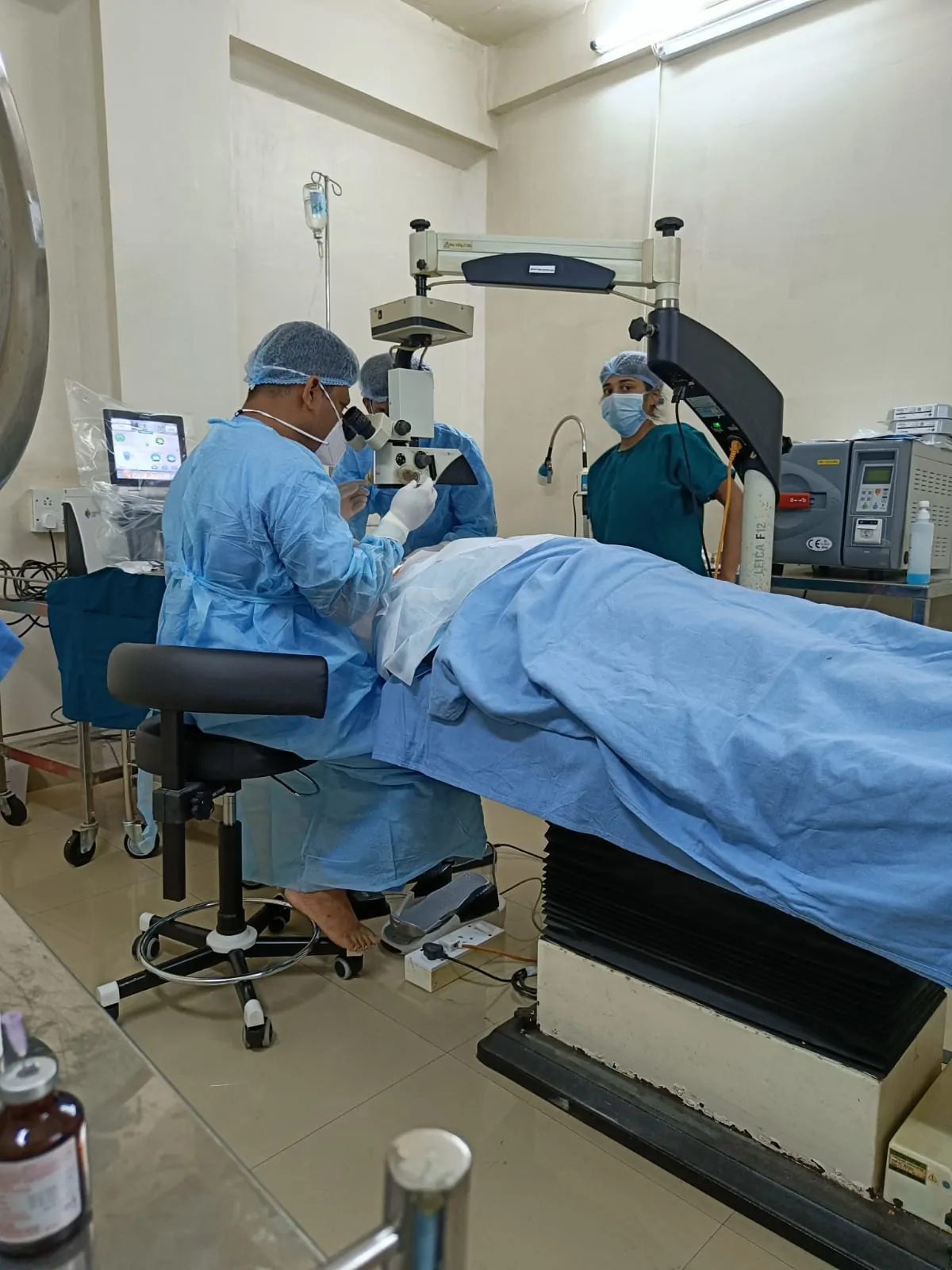
Painless, stitch-free cataract surgery using ultrasound, performed under an operating microscope, usually with numbing drops.
Laser vision correction
LASIK, PRK, SMILE and SMILE Pro use lasers to reshape the cornea and correct your glasses power. An implantable lens (ICL) is another option for very high power.
Collagen cross-linking
Riboflavin drops and a controlled ultraviolet light strengthen a weak cornea, to stop keratoconus getting worse.
IPL for dry eye (E-Eye)
Gentle pulses of light help blocked oil glands in the eyelids work again, easing evaporative dry eye.
Retinal lasers and vitreoretinal surgery
Lasers treat leaking vessels and retinal tears. Vitreoretinal surgery treats bleeding inside the eye, scar tissue and retinal detachment.
Not every test is needed for every patient. Some specialised tests may be arranged at a partner centre. Ask your clinic when you book.